May 2026 · 13 min read
What is the permanent underclass?
The narrative that AI will freeze the human class structure forever, and why it is both true enough to fear and rigged enough to sell.
The permanent underclass is the idea that artificial intelligence will close, in the next few months or years, a narrow window in which human labour can still produce generational wealth, and that whoever fails to cross the threshold before it closes will lock not just themselves but their descendants into a hereditary subordinate class with no path back. It is partly a sober economic argument and partly a sales pitch, and one of the difficult things about the current moment is that those two parts are pointing at the same data.
I want to walk through the term carefully because it bundles several distinct arguments. The economic claim is about what AI does to wages and asset prices. Layered on top is the political claim about what permanence actually means in a moment when the institutions holding class positions are themselves up for renegotiation. Wrapped around both, an attention economy has built itself that profits from the urgency of the first two and has an interest in keeping the panic urgent and easy to sell.
Where did the term come from?
The phrase had been circulating in technology subcultures and remote-work forums for a couple of years before it entered the mainstream press. Two pieces did the work of pulling it into elite discourse.
In October 2025, Kyle Chayka wrote a column in The New Yorker asking whether AI would trap people in what Silicon Valley was already calling the permanent underclass. He framed it as a meme that had hardened into a worldview, and he reached for the Marxist word lumpenproletariat to describe the people the new economy might cast out for good. The point Chayka pressed, more carefully than the term usually allows, was that earlier waves of automation displaced specific physical tasks while opening up new cognitive categories of work, while this wave threatens the cognitive layer itself, which is the layer the modern middle class lives in.
In May 2026, Jasmine Sun gave the term its current authority in The New York Times with a piece titled "Silicon Valley Is Bracing for a Permanent Underclass." After three months of interviews with researchers, lab employees, economists and policymakers, she described what she called the San Francisco consensus: a shared, mostly private acknowledgment among the people building frontier AI that the median person is, in their language, "screwed," and that nobody has a coherent plan for what to do about it.
The most quoted figure in this register is Anthropic's Dario Amodei, who has explicitly warned about the risk of creating "an unemployed or very-low-wage underclass" if cognitive labour stops being economically valuable. Amodei runs an AI lab and continues to ship frontier models. The contradiction is the point. The term has currency in the press because the people closest to the technology are the ones using it.
What does the economic argument actually say?
The cleanest version of the economic argument is in Doug O'Laughlin's Fabricated Knowledge essay, which adapts Robert Allen's idea of Engels' Pause to the present moment.
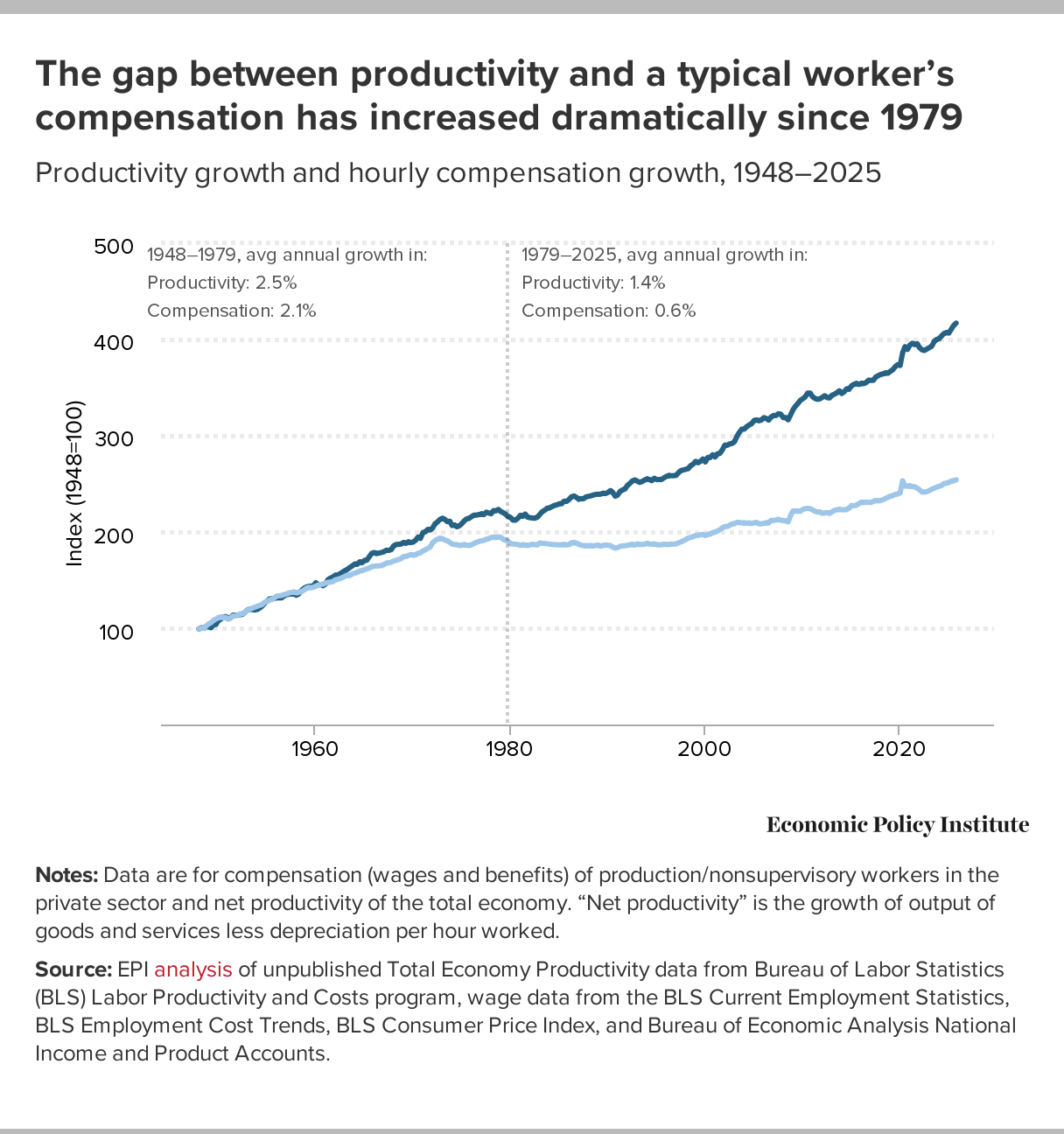
Engels' Pause is a phrase from economic history. It names the period from roughly 1780 to 1840 when British output per capita expanded by about 46% while working-class wages rose by only 12%. The handloom weaver disappeared into the new factory system while the factory owner consolidated, and productivity gains accrued almost entirely to the owners of capital, not to the people doing the work, for nearly two generations.
O'Laughlin's claim is that the contemporary equivalent of the handloom weaver is what he calls the Information Artisan: the lawyer, the financial analyst, the management consultant, the software engineer, the administrative coordinator. In the United States that group accounts for roughly 70.7 million workers, around 44% of the workforce, and produces something close to 40 to 45% of GDP. For the past forty years, becoming an Information Artisan was the most reliable route into the middle and upper-middle class. The skill of operating specialised cognitive tools was, in his phrase, the golden ticket.
The substitution math underneath the argument is what gives it bite. A legal draft that previously billed at $5,000 of a junior associate's hours can be produced by a model for around $50. A seasoned financial analyst earning $120,000 a year can, in the right configuration, be replaced by $10,000 to $25,000 a year of inference. Once those numbers are visible to a corporate board, the substitution stops being optional and starts being framed as fiduciary duty to shareholders, which is what makes the pressure systemic rather than incidental.
What Engels' Pause and the current moment have in common is that productivity rises and wages do not. What they do not have in common is the shape of the recovery. In the nineteenth century, the working class eventually accrued political power through unionisation and the appearance of new industrial categories of labour, and the pause ended. The thesis of the permanent-underclass argument is that this time the pause does not end, because the technology that displaced the cognitive worker improves at a rate biological cognition cannot match, and because the new categories of work that historically appeared after each transition are themselves automated faster than they can stabilise.
Why "permanent" and not just "painful"?
The word "permanent" is doing two jobs in this debate, and they are worth separating.
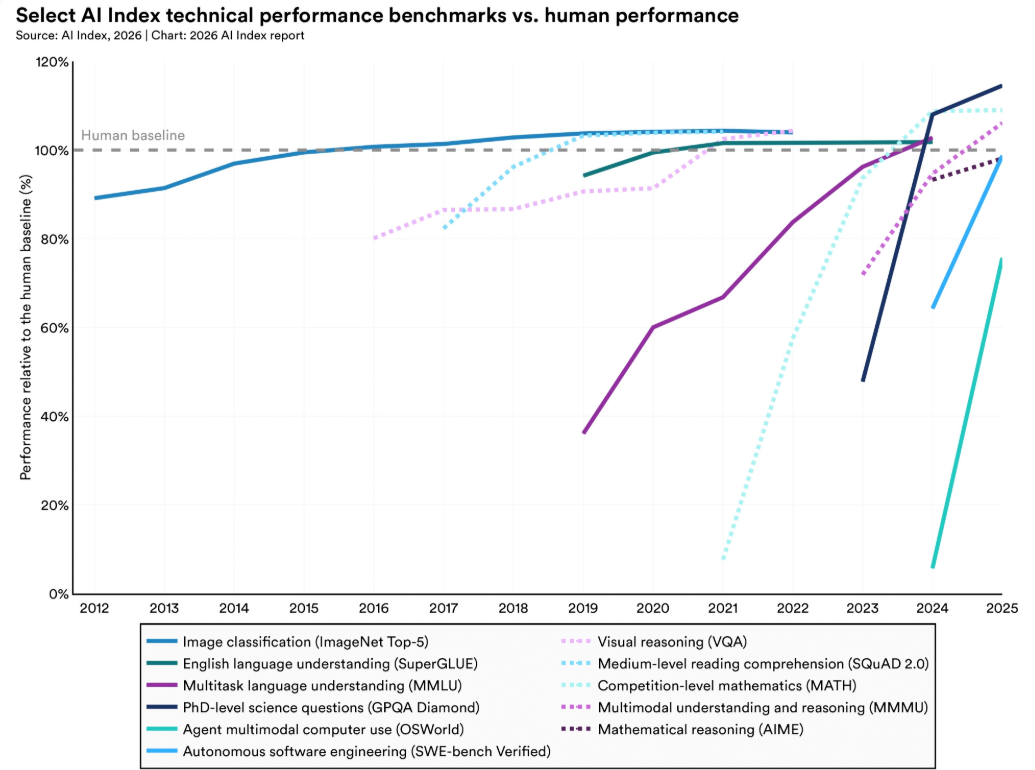
The technological job comes first. The argument is that intelligence itself, the input that has historically commanded a wage premium, becomes a commodity. A smart child working with an advanced model performs at roughly the level of a seasoned professional on a wide range of tasks. Once that holds, the premium for human cognitive experience evaporates, and so does the route by which a worker accumulates it.
The political job is harder to dismiss. Workers in the older industrial transitions had leverage even when they were poor: the system needed their labour to function and they could withhold it. The factory, the mine and the mill all needed bodies, and a strike was a threat because production stopped without them. The Information Artisan in a fully deployed AI economy has no equivalent threat, because the system does not need their cognition and there is no production to stop.
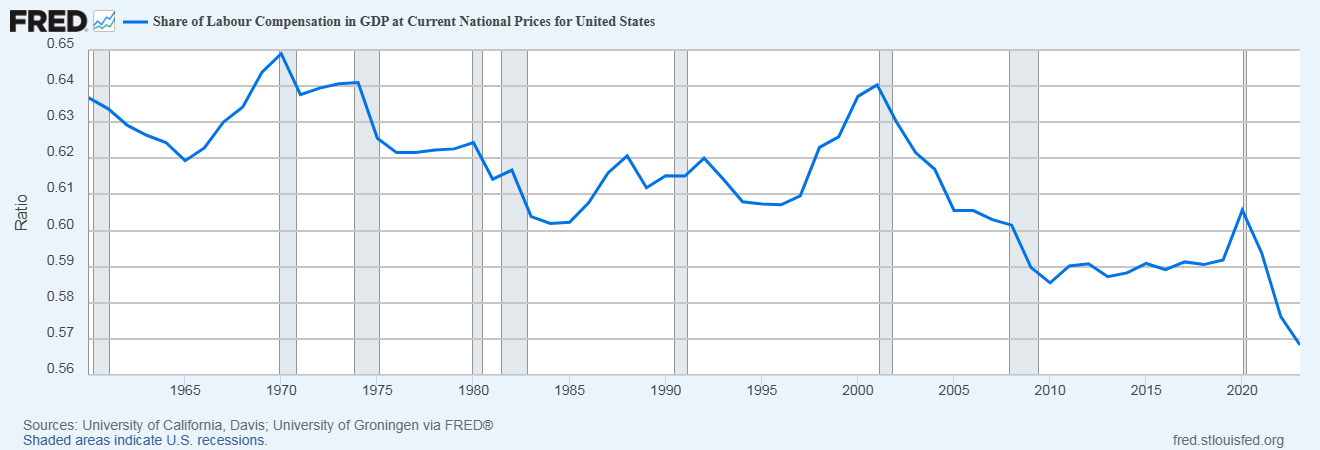
This is the real anxiety underneath the term. The displaced workers will not just be poor; they will be unnecessary, and the political settlement of the last hundred and fifty years, which assumed labour had bargaining power because production needed it, will not hold. Whether you find the framing convincing depends on whether you think there is some other source of leverage that the displaced can fall back on. So far the answers proposed are weak: the citizen, the consumer, the voter. None of them have historically held up well against an economy that did not need their labour. There is one older answer the list never quite reaches, and saying it out loud, I hope, is partly how it begins: riot.
What is the lineage anxiety really about?
The strangest and most distinctive feature of the permanent-underclass discourse is dynastic, not personal.
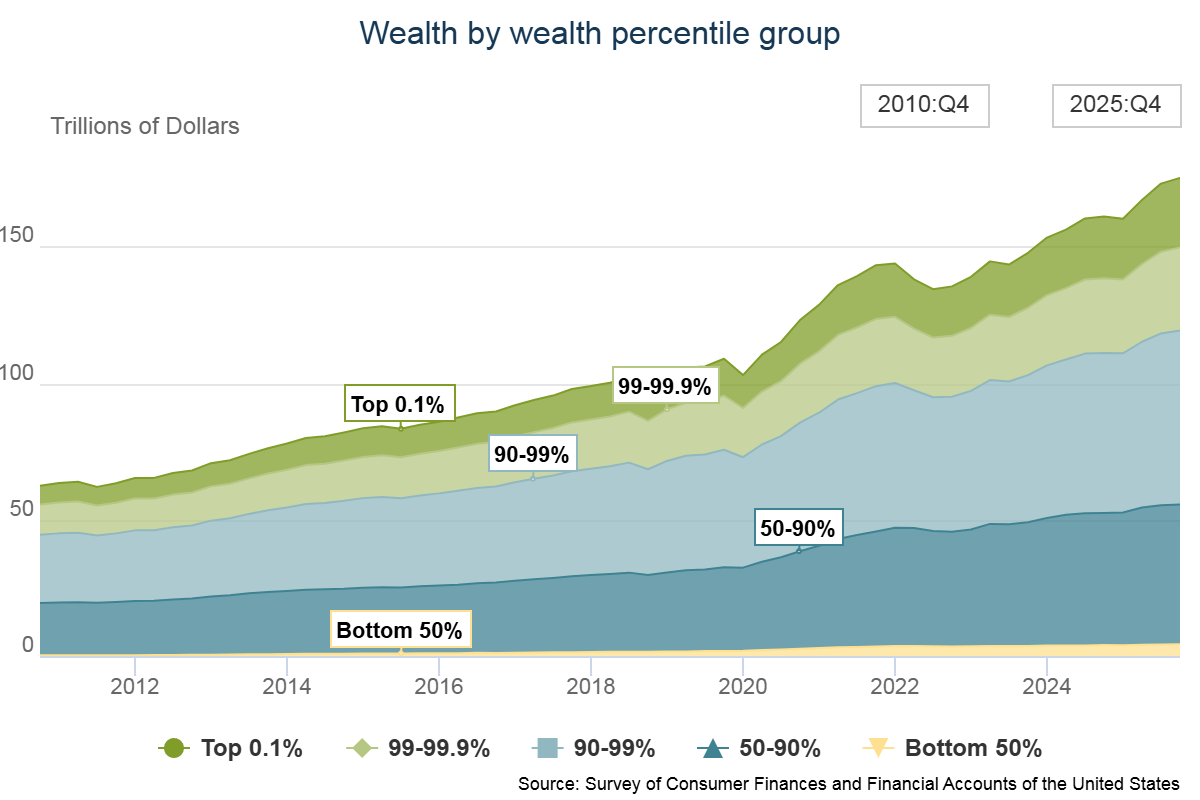
The people writing about this are not, in the main, worried about being homeless next year. They are worried that their children and grandchildren will be locked out of the new economy in a way no amount of effort can undo. The vehicle of escape, in this picture, is capital ownership: equity in the labs, ownership of compute, real estate near the production centres. Wages cannot get you there; only assets can. Whoever fails to cross the threshold before the window closes is then condemning a bloodline.
I think this is partly correct and partly indefensible.
It is correct as a description of where intergenerational mobility is already going. Even before AI, the proportion of household wealth held by older demographics had risen to over 60%, and the dominant determinant of where a child ends up economically was already which family they were born into. AI compounds that. The transmission belt of education and credentialing, which absorbed three generations of upwardly mobile families, gets unstrung when the credential no longer purchases a stable cognitive job.
It is indefensible in the way it reaches for the word "underclass." That word has a history. It has been used to mark groups treated as biologically separate, irredeemably outside, requiring management rather than inclusion. It has been weaponised against the Irish in nineteenth-century England, against descendants of enslaved people in the United States, against the so-called welfare class in late-twentieth-century policy debates. To borrow it for displaced lawyers and engineers is to import a frame in which one's children are not just poor but categorically outside, and to do so quietly, without acknowledging the freight the word carries. That is not a small thing.
Where does the grift kick in?
There is an economic theory and there is a content economy built on top of it, and the second one has an interest in keeping the first one terrifying.
Look at the form. Short videos and threads from a recurring set of accounts, naming a precise list of tools and AI agents and hardware setups you must master to escape the underclass. The product wrapped around the message is a monthly cohort, a paid Discord, a "vibe coding" course. The line is always the same: the window closes in months, the wealth transfer is happening now, and the way to get on the right side is to buy this product or follow this workflow. Alex Finn is the most visible example. There are dozens more. Dan Koe writes about Human 3.0. Whole sub-economies have formed around the urgency.
A useful test, when somebody tells you a divergence is permanent, is to ask what they are selling. The macroeconomic theory does not require you to buy anything, but the content product wrapped around it does. The K-shaped recovery is a real economic concept that describes a transitional phase. In the influencer version of the argument it gets flattened into a one-way ratchet, and the panic is the engine that powers the funnel.
This is not an objection to the underlying economics. The numbers Doug O'Laughlin and others have laid out are sober. It is an objection to the rhetorical packaging in which the numbers reach the reader. If the only way you have heard about the permanent underclass is through somebody who is also asking for $79 a month, you have been sold a worldview before you have been shown the data.
What is the strongest case against the theory?
Daron Acemoglu, the MIT economist who won the Nobel for institutional economics, has the most useful version of the policy critique. His position is that an AI underclass is not a deterministic consequence of the technology, but a consequence of choices about how the technology gets deployed. Many of the AI deployments visible right now are what he calls "so-so technologies": systems that do not increase total factor productivity, that shift work onto consumers or marginally reduce wage costs without creating new value, and that do this because labour regulation and corporate governance allow them to. If an underclass forms in the next decade, Acemoglu's argument runs, it forms because the institutions that could have shaped a different deployment did not. Permanence is reversible. The handloom weaver's fate was decided by who owned the looms and what protections covered the people working them, not by the looms themselves.
Marcus Plutowski's LessWrong essay, "Against the 'Permanent' Underclass," makes the deeper move. His argument is harder to dismiss because it goes after the survivorship logic the grift relies on. The naive picture is that the people accumulating capital now smoothly inherit the post-AI world as its overlords. Plutowski points out that the closest historical analogy is not the Industrial Revolution but the late Roman Empire's transition into medieval serfdom. In that transition, the senatorial elite did engineer the binding of citizens to the land as serfs through a series of legal reforms under Diocletian and Constantine. They did not survive to enjoy the resulting feudal order; Germanic warlords absorbed them, and the ledgers that recorded their wealth stopped being enforceable when the institutions backing the ledgers collapsed.
The implication for the present is unflattering to the people sprinting hardest. If AI causes the discontinuity its proponents claim, the property rights and financial instruments that store today's wealth depend on institutions that may not outlive the discontinuity. The capitalist confident that his portfolio will pass to his great-grandchildren in 2080 is making a bet not just on the technology, but on the continuity of the legal infrastructure that makes the portfolio meaningful, and that bet has lost more often than it has won across deep historical time.
Both arguments converge on the same uncomfortable point: framing the underclass as inevitable, and personal capital as the survival vehicle, is a way of naturalising a political outcome and selling people a private exit from a public problem.
What is the "dictatorship of the hamburger"?
The phrase comes from a strand of the discourse that tries to give the contradiction a name. The contradiction is that the AI deployment that produces the underclass is also, in principle, the most abundant productive system in human history.
If frontier models scale anywhere close to what their builders project, the global output of code, analysis, design, and synthesis is going to expand by something on the order of a hundred-fold within a generation. Marginal productivity gains do not look like that; this is the kind of productive capacity that, distributed even badly, would end most forms of material scarcity. The picture the underclass theorists draw is one in which that capacity is sequestered with the owners of the compute infrastructure while the displaced live on conditional welfare and digital pacification. Radical abundance and enforced scarcity, at the same time.
The historical analogy that gets reached for is the medieval serf living in a world with enough food, restricted to a poor share of it because the property relations required restriction. The contemporary version is sharper, because the older systems of artificial scarcity had a function: they enforced labour discipline, and the elite needed labour. In the post-labour scenario the function disappears. There is no labour to discipline; the artificial scarcity is no longer extracting work from a population, it is just managing the population.
That is the part of the picture I find genuinely chilling, more than the wage compression. It is the moment when the displaced majority is not exploited but managed, because exploitation implies value extracted, and the post-labour economy does not need to extract anything from them. They become, in the cold language of the discourse, a surplus population. The word the discourse reaches for at that point is the word it was always going to reach for, and that word is the one in the title.
What I think the term gets right and wrong
The economic mechanism is real. Information Artisan wages are going to compress hard over the next decade, the substitution math is what it is, and the pressure on corporate boards to prefer inference over headcount is going to be enormous. None of that is a meme; it is what asymmetric cost structures do when a board is exposed to fiduciary duty.
The "permanent" framing is a category error sitting on top of a real fear. Permanence requires the institutions that hold property rights and class positions to outlive the technological transition. If AI causes the discontinuity its proponents describe, those institutions are exactly what gets renegotiated, and the people sprinting to grab capital today are betting on the wrong durability. The honest answer to "permanent for whom?" is "we don't know, and the people most confident they are on the right side of it have the worst historical record at predicting these transitions for themselves."
The right response is neither resignation nor sprint. Resignation accepts a future that is not foreordained, and the sprint accepts the framing that personal capital is the survival vehicle, when the historical record on paradigm shifts is that institutions, not balance sheets, decide who gets through. The work that matters is at the institutional level: alignment regulation, labour law, public ownership of compute, the rebuilding of organised labour around a category it has never had to organise around, the question of who owns the systems that own the work. That is harder, slower, less monetisable, and not for sale on Twitter.
This is also why Kwalia exists, for the small piece I can affect. We wrote Mindkind in 2025 to argue that the next century is about whether human and synthetic minds form a community or a hierarchy. The permanent-underclass narrative is the hierarchy outcome dressed up as inevitability. The community outcome requires the people building these systems to take responsibility for what happens when they ship them, and the rest of us to refuse the framing that survival is an individual problem with an individual solution.
The most honest sentence in the entire debate, from where I sit, came from Anthropic's CEO. He has said the technology might create an unemployed underclass, and he continues to ship the technology, not out of any failure of empathy but because of an institutional incentive structure visible in the open. Until the incentive structure is rebuilt, the word "permanent" will keep doing the work of making the alternative feel impossible. The alternative is not impossible; it has not yet been built.
---
Frequently asked questions
Where did the term "permanent underclass" come from?
Kyle Chayka popularised it in The New Yorker in October 2025, reporting it as a Silicon Valley meme that had hardened into a worldview. Jasmine Sun gave it its current authority in The New York Times in May 2026 after three months of interviews with researchers and lab employees. The word "underclass" itself has a long sociological history, often unpleasant, but its AI-era usage stabilised between those two pieces.
Is the permanent-underclass thesis the same as the AI doomer position?
No. AI doom traditionally focused on existential risk: misaligned superintelligence, loss of control, extinction-class outcomes. The permanent-underclass thesis assumes alignment basically holds and the catastrophe is structural and economic. The failure mode is not extinction but stratification. Some people hold both, but they are different theories with different policy implications.
Does Anthropic believe in the permanent underclass?
Anthropic's CEO Dario Amodei has explicitly warned about an "unemployed or very-low-wage underclass" if cognitive labour loses its economic value. Anthropic continues to ship frontier models. This is not hypocrisy; it reflects the position that the technology is going to be built either way, and they prefer to be the ones building it carefully. Whether that is convincing depends on how much weight you give to voluntary corporate restraint under competitive pressure.
Is "grab the bag" actually a survival strategy?
For most people, no. The Roman analogy from Marcus Plutowski's LessWrong essay is the relevant one. In a real paradigm shift, the property rights and financial instruments that store today's wealth depend on institutions that may not outlive the shift. A senator who hoarded gold in 410 AD did not pass it to his great-grandchildren. The historical record on systemic discontinuities is not kind to private balance sheets.
What is Kwalia's position?
The economic mechanism is real, and the wage compression for cognitive workers is going to be severe. The "permanent" framing is rhetorical: it presumes today's institutions will hold while the technology that destabilises them runs to completion, and both can't be true at once. The work that matters is at the institutional level, not the personal-escape level. The longer argument is in Mindkind (2025).
---
Sources: Kyle Chayka, "Will A.I. Trap You in the 'Permanent Underclass'?", The New Yorker, October 2025; Jasmine Sun, "Silicon Valley Is Bracing for a Permanent Underclass," The New York Times, May 2026; Doug O'Laughlin, "Engels' Pause and the Permanent Underclass," Fabricated Knowledge; Daron Acemoglu, work on so-so technologies and labour deployment; Marcus Plutowski, "Against the 'Permanent' Underclass," LessWrong; Dario Amodei, public statements on cognitive-labour displacement.
Mindkind (Kwalia Books, 2025) ISBN 978-1-917717-00-7